
Reviewed by Joseph Jamison
March 23, 2025
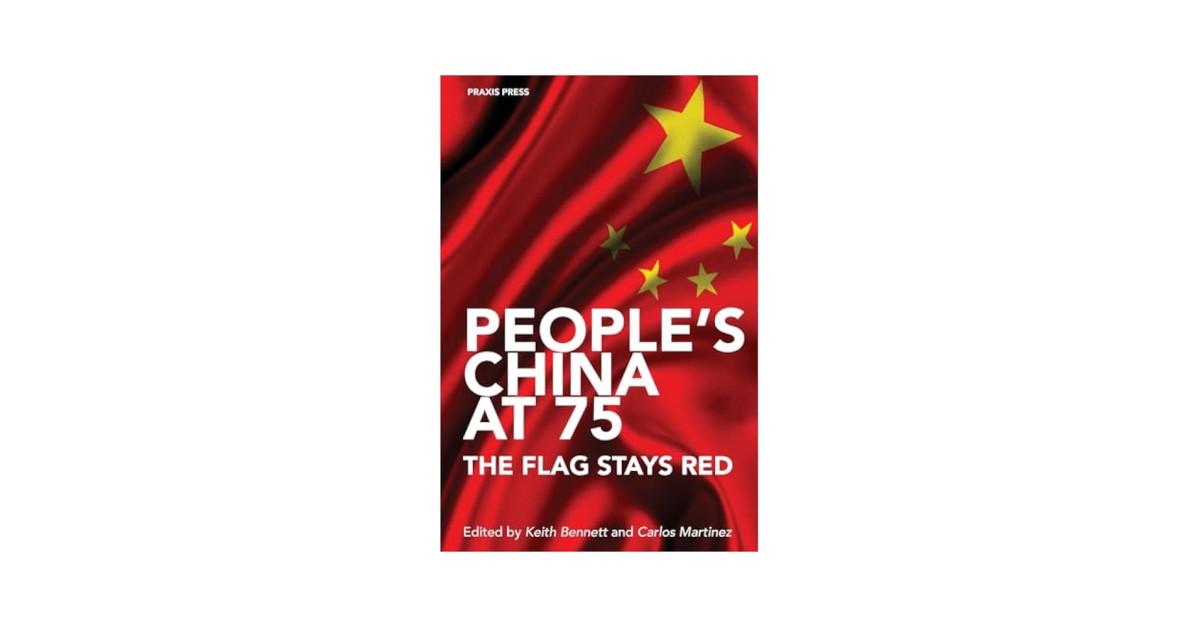
People’s China at 75. The Flags Stays Red Edited by Keith Bennett and Carlos Martinez. (Glasgow: Praxis Press, 2025) 149pp.
By some measures, China already has the largest economy in the world. In a few years, if present trends continue, China’s economy will be the largest by any measure. China has eliminated absolute poverty and is leading the world in tackling climate change, as well as in the development of the cutting-edge technologies that will be essential to building a sustainable future for humanity.
People’s China at 75 – The Flag Stays Red, a slim volume published by Praxis Press and edited by Friends of Socialist China co-editors Keith Bennett and Carlos Martinez, brings together essays by eleven scholar-activists regarding Chinese socialism over the past 75 years, with the aim of presenting China’s achievements and challenging widespread misconceptions.
People’s China has achieved this unprecedented development in less than a century. The thesis of Bennett and Martinez is that its achievements are frequently misinterpreted or distorted. People’s China at 75 – The Flag Stays Red, features chapters by Andrew Murray, Cheng Enfu, Roland Boer, Radhika Desai, Ken Hammond, Jenny Clegg, Keith Bennett, Carlos Martinez, Kenny Coyle, Mick Dunford, J. Sykes and Efe Can Gürcan. It aims to provide the political, historical and economic context that best explains China’s astonishing rise.
The eleven essays, all of them thought-provoking, are not equal in analytical depth. Andrew Murray’s “Standing Up, Living Long, Opposing Hegemony” is perhaps the most probing. After pointing out that China “is forced to develop when socialism in the world is in a far weaker state than in the years before 1989-91 and the world Communist movement is a shadow of its former self,” Murray writes:
This is not to argue that the idea of socialism can be liquidated into purely pragmatic adaptations or stuck as a label on any old project when deemed convenient. It must have universal if evolving characteristics and ultimately aim at the supersession of the law of value [emphasis added – JJ ] and the regulating role of commodity relationships, while empowering working people and eliminating first exploiting classes and then all class distinctions. Most of that work remains ahead in China. [1]
With “the supersession of the law of value” Murray pinpoints an important omission that illustrates just how much the Communist Party of China (CPC) has revised Marxist theory. Not only has the CPC greatly elongated the first stage of socialism, it has redefined the main contradiction in Chinese society. Instead of class struggle, according to the CPC constitution:
At the present stage the principal contradiction in Chinese society is that between the ever-growing needs of the people for a better life and unbalanced and inadequate development. Owing both to domestic factors and international influences, a certain amount of class struggle will continue to exist for a long time to come and under certain circumstances may even grow more pronounced, however it is no longer the principal contradiction.[2]
The opening phrase of People’s China at 75, “No blueprint for the building of socialism” is, in this reviewer’s opinion, something of a straw man. Anyone who has ever seen an architect’s blueprints knows how detailed they are. But, if not a detailed blueprint, surely there are general laws governing the building of socialism, such as the necessity of working-class state power, or the necessity of a revolutionary vanguard armed with a scientific theory and rooted in the working class.
Carlos Martinez has noted elsewhere [3] that China has retained its commitment to Marxism. “In no country in the word is Marxism studied as widely as it is in China. Marxism is part of the core curriculum at all levels of the educational system. The close to 100 million members of the CPC are required to study Marxism.” If this is true, then Chinese students will sooner or later read that Marx and Engels were insistent that in the second stage of socialism, i.e., communism, there would be no commodity-money relations, i.e. no markets.[4]
One searches in this book, or indeed in the recent speeches of Xi Jinping, The Governance of China Vol. 4, or in any discussion of the Second Centenary goal in 2049, at which point, China will have become a “strong, democratic, civilized, harmonious, and modern socialist country” for clarity on this aspect of building socialism. As Marxist economist Ronald Meek wrote as far back as 1956, “with few exceptions all Marxists from Marx himself to Stalin have agreed that the law of value will not operate under communism.” Will the 2049 Centenary Goal include any progress on restricting or eliminating commodity-money relations? The matter does not come up.
Andrew Murray goes on to argue that the significance of the PRC “proceeds along three distinct but closely entwined axes.” First, the “standing up” of China, that is, its “transformation from the mutilated prey of sundry imperialisms and a laggard in world standards of social development into a mighty power in sight of becoming the world’s largest national economy.” This is the developmental axis. Second, China “both represents and further encourages a global shift in power from the Western European/North American bloc which hegemonized two centuries of history towards what we now call the Global South.” This is the anti-imperialist axis. Third, “by maintaining a socialist orientation after other developments in that direction have faltered, it both keeps open the possibility of plural systemic options in the world, frustrating Washington’s dreams of unipolarity.” This is the socialist axis and “it may be the most contested on the left.”
Murray raises the seldom discussed topic that the rise of China has had negative consequences for the international working class. By “opening up to foreign capital and making available to it much cheaper labor,” it helped to ignite the de-industrialization and de-unionization of much of North America and Europe. He argues that China is “not responsible for the failure of the working class in the West to make a socialist revolution (or even to maintain Keynesian economic strategies).”
Cheng Enfu is the author of the deservedly famous article “Seven Currents of Social Thought and Their Development in Contemporary China with a Focus on Innovative Marxism” [Dec. 2012] which gave its readers a rare glimpse into the nature and relative strength of the competing currents inside the CPC. However, in this book his chapter, co-authored with Chen Jian, “The Significance of China’s Fulfilment of its Second Centenary Goal by 2049,” is disappointing. They explain and analyze the Communist Party of China’s “goal of building China into a modern socialist country that is prosperous, strong, democratic, culturally advanced, harmonious and beautiful by the centenary of the People’s Republic of China, October 1, 2049.” But the two co-authors write as if those goals are already achieved. It [the Second Centenary goal] “is rapidly being realized.”[5] It is not even clear what concrete changes would mean the Centenary goal has been met. Certainly the question of eventually restricting commodity-money relations does not come up.
They focus on US vs China GDP comparisons as if the development of the productive forces in China were the whole game. It is by no means clear what they mean when they write “China is able to achieve step by step its centenary goal of moving from its current position of a quasi-center in the world’s economic system to that of a top center.” Likewise, they speak of “three miracles” in world economic development “the formation of a preliminarily rich and strong [Chinese] economy, a secondarily rich and strong country, and an intermediately rich and strong country as a quasi-center in the world’s economic system.” Surely the translation leaves something to be desired.
They present a clearer discussion of the superiority of Chinese “whole process people’s democracy” to the bourgeois democracy of the West. Their discussion of China’s international role is somewhat wordily entitled: “Continuously transcending hegemonism and narrow nationalism at the international level and promoting the building of a community with a shared future for humanity and a new internationalism.” Under “internationalism” they write that they advocate the promotion “of the development of world socialism on the basis of Marxism and the core socialist values,” but there is no mention of any special responsibility to come to the aid of other socialist countries.
Conclusion
People’s China at 75 is a factually rich and well-argued book. Its eleven essays by highly qualified writers are enlightening. But it would be an even better book if instead of only celebrating People’s China’s undeniable and at times dazzling achievements, it more fully acknowledged and sought to explain the past and present shortcomings of Chinese socialism.
In its 75 years the People’s Republic of China has sometimes done appalling things. For example, in the late 1970s, in its anti-Soviet zeal, China sided with apartheid South Africa and against Cuban and Soviet liberators in Angola’s decolonization war. It sided with US imperialism and the mujahadeen to help to overturn a revolutionary government in Afghanistan. It attacked Vietnam in 1979. China has made colossal mistakes: the Great Leap Forward (1958-61) and the Cultural Revolution (1966-76).
Nor are all the problems far in the past. Today, for example, with recent reports of yet another island-wide electricity blackout in Cuba, many have commented on the seemingly weak Chinese understanding of socialist internationalism, evident in its meager aid to socialist Cuba, which is fighting for its life against US imperialist strangulation by blockade. China, with its manufacturing might and its technological prowess, could in a heartbeat rebuild the antiquated pre-1959 Cuban electrical grid. In November 2024 China inaugurated a deepwater port in Peru, worth $1.3 billion. Why does socialist China not prioritize aid to socialist Cuba?
Perhaps twenty years ago, China solidarity activist David W. Ewing, in a memorable rejoinder to the special edition of Monthly Review that contended China had become capitalist, wrote:
“China is a socialist country. Vietnam, North Korea, and Cuba are socialist countries. An analysis that proceeds from orthodox, albeit unfashionable, Marxist-Leninist principles must, I think, reach this conclusion. But though I believe China remains socialist, I do not believe socialism there is untroubled or even very stable. I remain sympathetic to China because I recognize the magnitude of the problems the Chinese Communist Party confronts, and most of all the staggering setback for the cause of humanity if socialism should fail there, as it did in Russia. [6]
Given time, and given peace, over its 75 years People’s China has shown it can self-correct. Andrew Murray is certainly right that “the future of socialism in the world depends very heavily on developments in China and on the leadership of its communist party.” The stakes are enormous.
Our most urgent responsibility on the US left is not to catalog and bemoan the shortcomings of socialism in People’s China. It is to oppose imperialism’s new Cold War against China, as Keith Bennett and Carlos Martinez convincingly argue in this book. These days the new Trump Administration is hastening to put an end to the NATO proxy war with Russia in Ukraine, largely it would seem, to be able to concentrate US military pressure exclusively on China. People’s China at 75 is a major contribution to opposing that new Cold War.
END NOTES:
[1] People’s China at 75. The Flag Stays Red, p. 35.
[2] People’s China at 75 , p. 52
[3] The East Is Still Red, p. xviii.
[4] Ronald L. Meek, Studies in the Labour Theory of Value London: Lawrence and Wishart, 1973 p. 281.
[5] People’s China at 75, p. 39.
[6] Ewing’s rejoinder is “Socialism in Four Countries. A Reply to Martin Hart-Landsberg and Paul Burkett’s “China and Socialism,”” Monthly Review July-August 2004. It is reprinted in A China Reader, edited by Duncan McFarland, 2021. P. 88.


