
By
He is not just another hawk in the bellicose aviary of the US capital; he is the meticulous watchmaker who adjusts the gears of other people’s suffering.
From an office on the seventh floor of the Harry S. Truman building in Washington, Marco Rubio, Secretary of State, plays at managing the life of an entire island, with the absolute coldness of someone who considers himself infallible and unpunished.
He is not just another hawk in the bellicose aviary of the US capital; he is the efficient employee, the meticulous watchmaker who fine-tunes the gears of others’ suffering. He is not a bureaucrat who merely stamps out orders; he is the hand that tightens the screws of economic strangulation, that decrees the genocide of an entire people.
He knows precisely the levers of power and the timing of American politics, he wants to be president and believes his time has come, supported by the pro-Israeli lobby and the anti-Cuban mafia of Miami.
His ties to the pro-Zionist lobby are longstanding. Norman Braman, a Jewish philanthropist from Miami, has been Rubio’s largest individual donor; through his organization Americans for Progress, he contributed more than two million dollars to groups that supported the Republican politician in the 2022 election cycle.
The Republican Jewish Coalition (RJC) even launched a six-figure digital advertising campaign in Florida supporting Rubio’s reelection on October 12, 2022. This is just to cite a few examples.
On the other hand, the Cuban American National Foundation (CANF), created in 1981 by Jorge Mas Canosa, perhaps the most influential organization of the radical exile, is a mainstay in Marco’s career.
Likewise, the US-Cuba Democracy, a PAC created in 2003 by businessmen hostile to Havana, is another key funder of Rubio.
Without the militant support of the hardline exile community, he would be nobody in the US political spectrum; in every campaign, the CANF structure, the Mas family businesses, the counter-revolutionary media, and the exile activists have functioned as a cohesive movement that guarantees him a secure base and high voter turnout.
Their political identity is built on defending a hard line towards Cuba, the discourse of the “dictatorship,” and the promise to never normalize relations without a total regime change.
Let us remember that Al Cárdenas, former director of the Republican Party of Florida and a historical figure of the Cuban exile, “discovered” him when he was a young lawyer, integrated him into the conservative power circle, introduced him to donors and paved his way to the presidency of the state House and then to the Senate.
This list would not be complete without the Fanjul family, Alfonso “Alfy” and José “Pepe”, the heirs of a sugar empire that originated in Cuba before the Revolution and who, after the expropriation of the sugar mills in 1960, rebuilt their fortune in Florida.
The family has not hidden its desire to see its former properties on the Island restored, and Rubio has made that demand a central point of his speech: insisting that any normalization involves compensating for the confiscated properties, which would directly benefit the Fanjul family.
Rubio is the most complete embodiment of the alliance between the anti-Cuban lobby, the economic power of the exile community, and the conservative right wing. In return, he has been the most faithful servant of the blockade and the suffocation, closing off all space for understanding and turning the policy towards Cuba into a private fiefdom shielded by particular interests.
Rubio has decision-making capacity, he has a budget, influence, and the power to stop the machinery he helped build; but he chooses not to, he chooses to blockade, he chooses to lie.
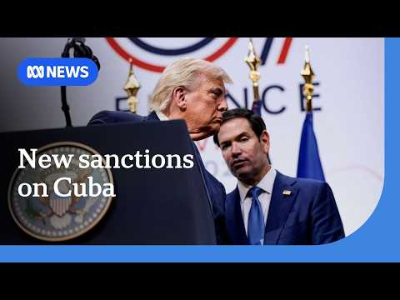
PHOTO: The United States has imposed new sanctions on Cuban companies. US Secretary of State Marco Rubio says the sanctions target five Cuban entities, including a business conglomerate run by Cuba’s Revolutionary Armed Forces, which commands nearly 40 per cent of the country’s GDP. (ABC News [Australia] June 23, 2026 video)


