By Raffaele Timperi
September 24, 2026 www.resistenze.org
Caracas’s gold is on its way to New York, and Israeli consulates are reopening [in Venezuela] after seventeen years. Those on the left who are searching for the exact moment of the “betrayal” are avoiding the real question: what was “21st-century socialism”?
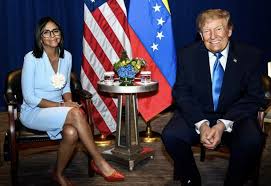
On September 23, from the podium of the 81st United Nations General Assembly, Venezuela’s acting president, Delcy Rodríguez, thanked Donald Trump “for his willingness to resume diplomatic relations and cooperation with Venezuela,” and took credit for “the recent binational agreement between the United States and Venezuela, one of the largest ever signed,” intended to contribute “to the energy balance of the hemisphere and the international economy.” She was speaking in New York, the very same city where Nicolás Maduro has been on trial in federal court since January. Maduro was not mentioned even once throughout the entire speech.
Five days earlier, on September 18, the Financial Times reported the deal moving 31 tons of Venezuelan gold, worth approximately $4 billion, from the vaults of the Bank of England to the New York Federal Reserve.
Delcy Rodríguez’s interim government gained legal control of the gold: it could not sell it immediately, but could use it as collateral for loans. Three weeks earlier, on August 29, Trump had announced from the White House “the largest oil deal in history”: twenty-five years, seventeen fields, approximately 65 billion barrels under US control, a fifth of the world’s proven reserves, with the Pentagon as a shareholder through a private company. On August 30, a thirty-year contract was signed for the Choco gold mine in El Callao with Heeney Capital and Mercuria. On August 11, Caracas and Tel Aviv reestablished consular relations that had been severed by Chávez in 2009, after an Israeli team intervened in the post-earthquake relief effort and an AIPAC delegation was received in the capital.
It wasn’t a right-wing government installed by the occupiers that signed all this. It was the PSUV. It was Maduro’s vice president, sworn in as interim president on January 5, two days after 150 US planes bombed the north of the country and Delta Forces removed Maduro and Cilia Flores from Fort Tiuna and transferred them to a federal court in New York. Twenty-nine days later, the same president signed the law privatizing the oil industry.
The alibi of betrayal.
The prevailing reaction among a certain Italian left has been the reiteration of a tried-and-true pattern: betrayal. They search for the exact moment—the signing in August, the law in January, the swearing-in on the 5th—as if searching for an original sin.
It’s the method the communist movement should have learned to discard long ago. All variations of betrayal, from the crudest to the most elaborate, treat a political experience as a legacy to be preserved and its history as a sequence of deviations from an original intention: reflection becomes limited to the search for the moment of rupture, which becomes a moral fault even before it becomes a political fact. No one denies that turning points exist. What is denied is that reading them as an original sin helps us understand the material reasons why a historical process went in one direction rather than another.
Betrayal is a consoling category: if the problem is men, the model remains valid. If Delcy Rodríguez betrayed, then “21st-century socialism” was right and must only be purged of traitors. It is the ideological operation that allows numerous organizations that refer, more or less directly, to communism to continue to cite that formula in their programs while its adopted homeland hands over its gold reserves to the US Federal Reserve bank and its gold deposits to the Pentagon. Defending the model, after all, does not mean defending Caracas: it means defending the political line that that word has legitimized here for twenty years.
What has never been expropriated?
In concrete terms, “21st-century socialism” has been this: a government won through elections and installed within institutions that have never been touched, the same army and judiciary as before, and generous social spending paid for with the proceeds of mining and energy nationalizations. No property relations have been overturned. The factories, banks, and lands have remained where they were, and with them the class that owned them.
One only had to look at what was happening in 2020. On the eve of the parliamentary elections that December, to secure the support of opposition parties, the government was cutting wages and allowing Venezuelan capitalists to undergo mass layoffs. The PCV had just left its alliance with the PSUV and formed the Popular Revolutionary Alternative; in response, it was excluded from televised debates and accused by the governing party of “playing the right’s game.” A redistribution based on rent, which had not touched the capitalist basis of economic relations, showed its weakness there: rent would only have to shrink for wages to pay, and the bourgeoisie would once again be the ally to be sought.
Six years later, the PCV—which has since been judicially stripped of control of its party symbol—is the only organized force denouncing “the new and grave confiscation of the national patrimony carried out by the illegitimate triumvirate,” accomplished “behind the backs of the Venezuelan people, without transparency, and outside of constitutional controls”: a “wild plunder” disguised as “technocratic rhetoric.” And it does so without aligning itself with María Corina Machado. Those who weren’t in government don’t have to explain today why the government signed: that’s the whole point of class independence.
There was no rupture, there was continuity. The apparatus that repressed workers’ strikes, criminalized communists, and administered an oil revenue for a decade, fostering the growth of a bourgeoisie within the state, faced with the collapse of the revenue and the January bombings, did what every bourgeoisie does: it sought the best deal with the strongest capital. It hasn’t betrayed its class nature, it has shown it.
Campism put to the test.
For years, in Italy, Venezuela has been the exemplary case of an entire political position: the idea that there exist “anti-imperialist” capitalist states to be supported as adversaries of Washington. In eight months, that bastion has become the privileged supplier of the US strategic reserve, 41% depleted by the war with Iran, and Israel’s consular interlocutor.
It’s not a paradox; it’s the way it works. When you support a capitalist state because it occupies the right square on the chessboard, you end up supporting those sectors of the national bourgeoisie that at that moment have an interest in trading with Washington’s rival. But interest isn’t fixed forever: the balance of power changes, alliances are re-organized, and the same bourgeoisie that yesterday signed in Beijing and Moscow today signs in Washington without having changed its nature one iota. The buyer changes, not the seller.
Those who had built their political identity on the geopolitical positioning of that government, and not on an analysis of the production relations that sustained it, must now explain why the bastion signed, and they do so by speaking of capitulation: that is, dismissing as an accident what was the product of that structure.
Chávez’s break with Israel in 2009, in the midst of Operation Cast Lead, was among the most praiseworthy acts of that foreign policy. The fact that it was reversible in seventeen years, and reversible by the very hands of his heirs, is a measure of the value of international positions that are not rooted in the class nature of the state that adopts them.
No concessions, in any direction.
None of this mitigates the impact of the aggression. A country was bombed, its president abducted by commandos and tried in a foreign court, dozens of Venezuelan soldiers and thirty-two Cubans killed, its mineral and energy resources divided by contract, and the proceeds deposited in an account controlled by Washington. This is an act of imperialist war, and it is the model the United States is building for the continent. There is no equidistance to be maintained on this, and the denunciation must be carried to the full, starting with the Italian government and the Italian companies that are already returning to Venezuelan oil fields.
But denouncing imperialism does not require inventing a socialism that didn’t exist. Only a materialist analysis of the true nature of the Bolivarian process allows us to understand why it lacked the strength to resist, and why its leadership was recyclable as administrators of the spoils. A power that hadn’t expropriated the bourgeoisie couldn’t call on the working class to defend it, because it had never given them anything to defend except a certain level of income.
Cuba, where property relations were effectively overthrown, has maintained a blockade for sixty-five years. The comparison isn’t based on military power relations, which are not comparable: it’s based on one point alone, namely, that there exists a class there that has something of its own to defend, and knows it. A new century hasn’t changed the basic condition: either the working class takes the means of production from the bosses, or it ends up administering their state on their behalf.
The assessment we need isn’t on Caracas, but on those here who continue to explain that an intermediate stage must be passed first, that institutions can be administered as long as “progressives” govern them, and that socialism will come later. Those who seek out the traitor aren’t taking stock. They’re looking for a way not to.
-This article originally appeared at https://www.lordinenuovo.it/autore/raffaele-timperi/
www.resistenze.org – Resistant Thought – Theoretical Debate – September 30, 2026 – No. 971