Reviewed by Joseph Jamison
October 20, 2026
____________________________________________________________________________
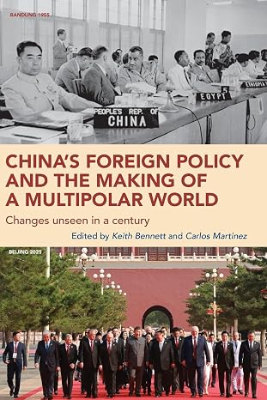
China’s Foreign Policy and the Making of a Multipolar World. Changes Unseen in a Century. Edited by Keith Bennett and Carlos Martinez. (Praxis Press, Glasgow, Scotland, Great Britain, 2026. 149 pages.)
____________________________________________________________________________
This book, China’s Foreign Policy and the Making of a Multipolar World. Changes Unseen in a Century is largely the work of the activists, writers and scholars who contribute to the web site Friends of Socialist China. The book’s co-editors Keith Bennett and Carlos Martinez are the co-editors of Friends of Socialist China. Keith Bennett is a veteran Marxist and one of Britain’s foremost specialists on socialism in China and in the DPRK. Carlos Martinez is an author and activist based in London. His previous books are The End of the Beginning: Lessons of the Soviet Collapse (2019); The East Is Still Red: Chinese Socialism in the 21st Century (2023); and People’s China at 75: the Flag Stays Red, also co-edited with Keith Bennett,(2024).
China’s Foreign Policy consists of ten essays about the People’s Republic of China’s (PRC’s) foreign policy, and it is the first of a projected two volumes. It aims to “set out the broad contours, historical background and theoretical underpinnings that shape and guide China’s practice on a global stage.” The subsequent volume will examine “how these serve as a theoretical and practical guide across the various theaters of China’s omnidirectional foreign policy…”[1]
The most important essays in China’s Foreign Policy are the Introduction by Bennett and Martinez which sets the political direction, and the first chapter “Understanding the Changes Unseen in a Century” by the same two authors. The Introduction declares:
“This book sets out to examine modern China’s foreign policy in detail. What are its historical roots? What are its theoretical foundations? How has it been applied in practice, across radically different historical circumstances? Is China an imperialist power? Is its foreign policy “good enough”? And what does China’s rise mean for the rest of humanity – for the Global South, for the prospects of peace, and for the long struggle to build a more just world order?…”[2]
“Taken together these essays make a sustained case that China’s foreign policy is neither the menacing expansionism imagined by the China hawks nor the timid and unprincipled inadequacy lamented by some on the left, but a coherent, principled and historically grounded strategy oriented towards a multipolar world of sovereign equality.”[3]
The main thesis of China’s Foreign Policy is that China’s rise should not primarily be understood as the emergence of a new imperialist or hegemonic power, but as a major force behind the transition from a U.S.-dominated unipolar international system toward a more multipolar world order.
Carlos Martinez contributes two additional chapters “Is China Imperialist?” and the last chapter “The Four Global Initiatives and the Political Meaning of a Community of a Shared Future for Humanity.”
The other essayists are names familiar to those who follow the Friends of Socialist China website or The Morning Star: Jenny Clegg “Taking the Five Principles of Peaceful Co-Existence as a Guide”; Ken Hammond on “Change and Continuity in China’s International Relations, 1949-2025”; Andrew Murray on “China, Cold War, and Empire”; the prominent Chinese economist Cheng Enfu “How China’s Peaceful Rise Is Changing the World”; Danny Haiphong “Is China’s Foreign Policy Good Enough? and Michal Dunford “Why Chinese and Western Visions of World Order Differ and Why the Difference Matters.”
As the ten essays point out, there are, in truth, many things to admire about China’s foreign policy under President Xi Jinping (2012 to the present). One example: the now oft-overlooked Chinese attempt in 2024 to build Palestinian unity by bringing 14 Palestinian parties and factions together — including bitter rivals Fatah and Hamas — which resulted in the Beijing Declaration of July 23, 2024. While not ultimately successful in forging lasting Palestinian unity, it represented a significant diplomatic endeavor.
Other important examples: In recent years Xi Jinping has proposed four initiatives: the Global Development Initiative ( GDI 2021), the Global Security Initiative (GSI 2022), The Global Civilization Initiative (GCI 2023), and the Global Governance Initiative (GGI 2025). These initiatives spell out Xi’s belief that in the 21st century the great challenges facing humanity—climate breakdown, pandemics, the threat of nuclear war, the vast and persistent inequalities of the world system—can only be solved on the basis of international co-operation. The initiatives represent an attempt to promote an advanced modern program for international relations in the 21st century.
Regarding the four initiatives, Carlos Martinez notes “each addresses a fundamental pillar of international co-operation towards the shared future for humanity: The GDI seeks to lay the economic foundation, the GSI to safeguard stability and peace, the GCI to foster understanding and friendship, the GGI to supplement the institutional architecture of the existing UN multilateral system. Martinez claims, “…taken together, the four initiatives articulate something far more than just a foreign policy package ; they sketch a deeply humane and essentially Marxist pathway towards a post-imperialist world order”.[4]
China’s recent foreign policy has been peaceful. As Martinez observes, “China’s record, by contrast [with that of the United States], has been extraordinarily peaceful. Since the founding of the People’s Republic in 1949, China has participated in very few wars. It intervened in the Korean and Vietnamese wars on the side of the victims of U.S.-led imperialist aggression and was involved in brief, limited border clashes with India (1962), the Soviet Union (1969), and Vietnam (1979). In the nearly half-century since, China has not been at war. Its per capita military spending is roughly one-twentieth that of the United States. Although China is a nuclear power, it maintains a strictly defensive posture. It has about 500 nuclear warheads, compared with 5,500 held by the United States, and has maintained a no-first-use policy since its first successful nuclear test in 1964.”[5]
Earlier Chinese foreign policy was not so peaceful. After 1956, the growing split between the Communist Party of China (CPC) and the Communist Party of the Soviet Union led to major disruptions and disunity in the world Communist movement. Around 1971 the CPC’s anti-Sovietism led to a de facto alliance with the US under Nixon and Kissinger. Anti-Sovietism impelled China in the 1970s to back UNITA in Angola,[6] where the Soviets and Cubans were aiding the genuine anti-colonial movement the MPLA.
Just how peaceful China’s foreign policy is nowadays only requires a brief contrast with Trump’s bellicose foreign policy. Yearly Pentagon spending now surpasses a trillion dollars. The US shows contempt for the UN system and multilateralism. With Israel, in 2026 the US launched an unprovoked war with Iran. The US remains a prime mover behind the four-year-old proxy war against Russia in Ukraine. The US is intensifying its encirclement of China through a military buildup in the Pacific, initiating provocations in the South China Sea and the Taiwan Strait, and developing the AUKUS nuclear submarine pact with the UK and Australia. The US has provided unconditional support for Israel in its genocidal onslaught in Gaza. “Through its tariff war, its semiconductor export controls, its financial warfare and its vast regime of unilateral sanctions, the US is seeking to hobble the economic rise of its rivals and to punish any nation that dares to defy it diktat.”[7]
Evaluation
China’s Foreign Policy does not take up the question “Is China building socialism?” That is taken as a given. The book does not deliver, as promised, on the matter of the “historical roots of China’s foreign policy.” That would entail a discussion of the unique class nature of the Chinese revolution, as British historian R. Palme Dutt stated in his brilliant 1967 essay Whither China? written amid the chaos of the Cultural Revolution:
… All these special characteristics of background and class alignment need to be taken into account in order to understand the problems of the Chinese revolution. The victory of the Chinese socialist revolution, led by the Communist Party, took place in a predominantly peasant country, where the main preceding content of the revolution was the national anti-imperialist and anti-feudal armed struggle, with the main basis in the peasantry; where the main body of the working class was for prolonged periods cut off from directly leading the national revolutionary armed struggles based on the peasantry; and where the leadership of the working class was in consequence expressed through the leadership of the Communist Party, drawn from the most progressive national revolutionary fighters who had come over to Communism. In this background and class alignment the potentiality of all the problems which have broken out into the forefront in the present phase can be traced. [8]
Not enough attention has been paid to the exchange on China that took place over the summer 2026 in these pages. With rare civility (and hence a model for all) Greg Godels and Carlos Martinez debated the major questions in the Communist movement surrounding China, including its foreign policy. This reviewer found especially impressive Godel’s forceful criticism:
I challenge China’s foreign policy. I believe that the PRC’s departure from the proletarian internationalism that served as the foundation for the Communist International and for a united and fighting world Communist movement has frequently placed it on the wrong side of history.
From the break with the Soviet Union, China has fallen short on international solidarity and opposition to the imperialist system. Driven by anti-Soviet animus, China sowed disunity among Communists and anti-imperialists and placed unnecessary obstacles in front of support for the heroic Vietnamese struggle against US imperialism (for example, instigating a break with the Japanese Communist Party). China forged an unholy rapprochement with the US leadership at a critical juncture of that [the Vietnamese] struggle. The leaders valued discrediting Soviet and Cuban assistance to countries seeking liberation or advancing an independent course over advancing the struggles of those countries. China invaded Vietnam in 1979. The PRC justified these retreats from a class-based policy by adopting a non-Leninist Three Worlds Theory that equated US imperialism with Soviet “social-imperialism.”
With the demise of the Soviet Union, the post-Mao PRC embarked on a foreign policy devoid of class alignments and class interests. In place of constructing policy around the interests of the working class, China defines the central contradiction to be between the US and its closest allies and a vague “Global South,” a slippery concept that includes the greatest, most powerful rival to the US, other emerging economic powerhouses, and the poorest, most economically deprived countries; countries ruled by tyrants, by popular regimes, or by bourgeois democracies; and countries defiant of the US, countries allied with the US, and countries supplicant to the US. In short, there is no discernible basis– certainly no class-based relationship– linking these varied countries together today. Moreover– paradoxically– China has unqualified and economically productive relations with both sides of the “contradiction.”
Accordingly, China is absent from international campaigns against egregious violators of even the most basic moral values, like the economic boycotting of the genocidal regime in Israel. It is not so much that PRC foreign relations are consistently malignant as it is that they are incoherent and disappointingly neutral from a class perspective.
This incoherence is witnessed in China’s lack of militant engagement with the burning international issues of the left at this moment: the Israeli genocide, the current US war with Iran, the exercise of the Monroe Doctrine in Venezuela, or the strangling of Cuba. Is this what the left accepts as fighting the imperialist system? [9]
China’s internationalism
Lenin and subsequent Soviet leaders had a clear understanding of proletarian internationalism [10]
As Roger Keeran has pointed out,[11] in place of the kind of internationalism advocated by Lenin, the Chinese Communist Party has developed its own kind of internationalism that Xi Jinping has called “win-win.” This internationalism involves encouraging the peaceful development of other countries while respecting their sovereignty and not interfering in their internal affairs.
Chinese internationalism is exemplified by the so-called Belt and Road Initiative. The essence of this initiative is that China invests in the infrastructure of other countries, building ports, airports, railroads, and hospitals, while gaining for itself access to raw materials and markets. Between 2013 and 2022, China invested 932 billion dollars in 2,300 projects in 147 countries. Unlike the United States and the International Monetary Fund, China has not demanded that these countries privatize state enterprises or make other concessions. In Africa alone, in twenty years, China constructed 20 ports, 13,000 kilometers of roads and railways, 170 schools, 130 medical centers, 80 electrical stations, 45 industrial parks, and cultural centers. With the exception of a base in Djibouti, China has not established foreign military bases as part of its investments. The US has an estimated 800 foreign military bases.
The Chinese have followed an international path of peace and mutual respect that contrasts sharply with American imperialism. While Chinese firms abroad have sometimes mistreated workers, China has also acted to respect local laws and local sovereignty. In 2021, the government of Democratic Republic of the Congo accused Chinese corporations of illegally exploiting miners. The Chinese government responded immediately by fining the companies and demanding that they leave.
In short, to say that China has abandoned internationalism or that its economic behavior abroad is equivalent to American hegemony and imperialism would be grossly misleading. Still, the internationalism practiced by China is far more transactional than that of the Soviet Union. With the Soviet Union, internationalism meant giving aid and support to liberation movements and fraternal socialist countries because, on the basis of class solidarity, it was the right thing to do. Under win-win, China expects to get something and does get something in return for its investments. For a country not well endowed with natural resources like Cuba, this means little can be expected of China, and in contrast to the generous support that the Soviets provided Cuba, Chinese aid has been modest [12]
Some Questions about Multipolarity
A long essay (36 pages) by Torkil Lauesen, a Danish communist writer, entitled “The Principal World Contradiction and China’s Pursuit of Socialism” traces the CPC’s understanding of the principal contradiction from Mao to the present. Lauesen concludes that the current principal contradiction is: “The decline of US hegemony versus the rise of China, and the development of a multipolar world order.”
Bennett and Martinez see the goal of multipolarity as a central concept of Chinese foreign policy. In fact, they see it as the road to socialism.[13] The book’s ten essays “share a common premise: that China’s emergence as a global power, far from being a threat to humanity, offers the best hope for a peaceful, multipolar, and ultimately socialist future.” [14] They declare in the very first pages of the Introduction that the US war on Iran was “a war against an emerging multipolarity,” not merely an attack to reassert US imperialist dominance in West Asia, nor an attack carried out at the instigation of Israel. The US was attempting to “arrest the whole process of multipolarity that had been unfolding across the world, and to reassert its dominance over a world that is slipping from its grasp.” [15]
In the useful Glossary provided at the end of the book the editors define multipolarity as “an international system with several centers of power, as opposed to a single hegemon (unipolarity) or two opposed blocs(bipolarity) ; a stated objective of Chinese and Global South diplomacy.” But elsewhere they quote Xi Jinping [16] who declares a multipolar world order is one where “all countries regardless of their size, strength, and wealth are equal members of the international. community,” where all countries “have common interests, common rights, and common responsibilities in international affairs.”
An end to the US reign as the dominant world power since 1991 is certainly a laudable goal, and for the sake of the argument let the reader assume it is somehow soon achieved. What would be the result? It would leave socialist China among a number of capitalist imperialist great powers, including the de-throned US, all of which are rivals, all of which have the same rapacious warlike nature, whose economic systems are unstable, whose ambition, in all likelihood, is to become the new “unipolar” hegemon. Since 1978, China’s policy has integrated the Chinese economy fully into the global capitalist economy. Aren’t there, as a result of such integration, extraordinary risks of China’s entanglement in inter-imperialist rivalries, rivalries that could well result in war? Is the goal of multipolarity, then, such a desirable strategy for China?
Moreover, why would imperialist states embrace Xi’s rosy version of multipolarity? When has imperialism ever embraced the equality of nations large and small? The co-editors endorse Jenny Clegg’s idea that “multiple centers of power, all with a certain capacity to influence world affairs, will shape a negotiated order,“[17] that multiple centers of power fundamentally undermine the capacity of any single country or bloc to impose its will on the rest. This is, surely, wishful thinking.
Notwithstanding these questions and criticisms, China’s Foreign Policy is a valuable book. It is an informative guide to how the Chinese leadership conceives of its foreign policy. The co-editors and contributors make a convincing case that China’s current foreign policy is broadly oriented toward peaceful coexistence, sovereignty, economic cooperation, and greater political autonomy for developing countries, rather than toward establishing Chinese global hegemony. The book explicitly presents this as a contested interpretation, particularly against Western government and mainstream media narratives, eager for a new Cold War, that portray China’s rise as inherently expansionist or imperialist. China’s Foreign Policy challenges the basic assumptions of those who want a new Cold War.
This slim volume begins with many testimonials. In one, the eminent British Marxist historian John Foster observes that the co-editors “view China’s foreign policies as the basis for something the world urgently needs: ‘a global united front against imperialism.’” Nothing is more urgent. Let us hope their view is correct.
____________________________________________________________________________________
[1] China’s Foreign Policy, p xviii
[2] Ibid. p. xiv.
[3] Ibid. p. xvii-xviii.
[4] Ibid. p. 132.
[5] Ibid., p. 46.
[6] Carlos Martinez acknowledges Chinese support for UNITA was an error.
[7] Ibid., p.8.
[8] See Marxist Internet Archive, www.marxists.org, Rajani Palme Dutt. “Whither China?, 1967.
[9] Greg Godels “More on China: A Reply to Carlos Martinez’s Reply,” MLToday August 5, 2026.
[10] Theory and Practice of Proletarian internationalism. Edited by M.S. Junusov. Progress Publishers: Moscow 1976. “The basic principle of proletarian internationalism is revolutionary solidarity and unity of the workers of the whole world. This includes: “The subordination of national interests to the international interests of the workers of the whole world is a principle of proletarian internationalism, including readiness to make national sacrifices for the sake of international interests.” The authors cite the Brest-Litovsk Treaty (1918), signed by the beleaguered Soviet government and involving vast territorial concessions to Germany as an example of proletarian internationalism. It was signed to preserve the Soviet Republic as a basis for world revolution p. 43.
[11] Roger Keeran, “Review of Bruno Guigue’s The Chinese Odyssey.” MLToday. February 10, 2026.
[12] China’s help to Cuba in the island’s current crisis should not be exaggerated. The solar panels, while welcome, provided by China to Cuba supply only a modest percentage of Cuba’s energy needs at present. Supplies of rice have likewise been modest. Cubans must feel abandoned during this US-imposed oil blockade when one considers the extraordinary solidarity the Cubans (and the Soviets) showed to African liberation struggles in the 1960s and 1970s. Cubans lost more than 2000 soldiers in Angola fighting pro-apartheid forces. More recently, as of 2025, about 24,000 Cuban doctors and other medical professionals were officially reported to be working abroad in 56 countries.
[13] China’s Foreign Policy pages xiv-xv.
[14] Ibid. p. xiv-xv.
[15] Ibid. p. xiii.
[16] Ibid. p.6.
[17] The co-editors cite Jenny Clegg’s China’s Global Strategy: Towards a Multipolar World (2009)