
Reviewed by Robert Supansic
February 10, 2026
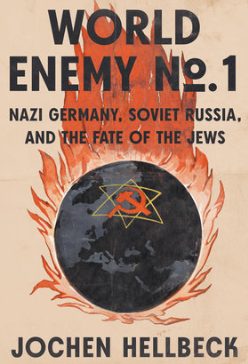
World Enemy No. 1: Nazi Germany, Soviet Russia, and the Fate of the Jews, by Jochen Hellbeck. (Penguin Press, Oct. 2025. 560 pages.)
During the Cold War the history of World War II was radically rewritten, reflecting the conflict between the U.S. and the Soviet Union. World War II, it is said, was won on the beaches of Normandy and – against all evidence – not on the steppes of the Soviet Union. Indeed, it was American Lend Lease aid that saved the Soviets from defeat. The cause of the war was Hitler’s obsession with Jews. The Jewish Holocaust emerged as the central German war crime; the other holocaust against non-Jews largely disappeared from the pages of history.
In World Enemy No. 1: Nazi Germany, Soviet Russia, and the Fate of the Jews, Jochen Hellbeck attempts to correct some of those misconceptions. It is an honest book in a field desperately in need of one.
One widespread misconception concerns the development of Nazi anti-Semitism. The Nazis did not ride anti-Semitism to power by a wildly receptive German public. After World War I all European parties of the right became fiercely anti-Bolshevik. To put some flesh on that abstraction they began to speak of “Jewish Bolshevism.” (Jews supposedly spent their days working hard to grow rich from capitalism and then worked equally hard at night to undermine it.) The Nazis relentlessly beat the drum of “Jewish Bolshevism” though even in Mein Kampf (1924), Hitler did not offer a solution to the “Jewish problem.”
The Nazi campaign against “Jewish Bolshevism” did not ignite a prairie fire. In 1928 the Nazis held only eight seats in the Reichstag. The subsequent explosion of Nazi political support came only with advent of the Great Depression in 1929. On Hitler’s appointment as Chancellor in 1933 there were only 500,000 Jews in Germany, reduced by 1939 to 250,000 mainly through forced emigration. Widespread anti-Semitism allowed many Germans to look the other way at Hitler’s brutal treatment of German Jews but by 1939 many Nazi leaders thought the “Jewish problem” could be solved by their forced deportation to Madagascar. In the West, Hitler’s treatment of Germany’s Jews was often deplored but dismissed as a German internal matter.
Hitler’s invasion of Poland in September 1939 changed everything, bringing, for the first time, millions of Jews under Nazi control. This fact did not immediately register with the German public and was almost completely ignored in the West. In January 1939, Hitler finally revealed that, should Jews start another world war, the result will be “the annihilation of the Jewish race in Europe.” In March 1939 he also called for “the annihilation of the Bolshevik commissars.” The crusade against “Jewish Bolshevism” became a dominant theme in Nazi propaganda. It appealed to anti-Semites and anti-Communists, though it was never clear about which part of that formulation its adherents found most exciting. Furthermore, the attack on Poland in 1939 unleashed a separate racism, one tapping into widespread German fear and hatred of the bestial Untermenschen (“subhumans”) to the East.
The second misconception, according to Hellbeck, is that Hitler invaded the Soviet Union because he had a Jewish obsession which could only be satisfied through genocide. In fact, his main objective was the destruction of Soviet socialism and the capture of its resources for Germany. This was expressed in Hitler’s open campaign for lebensraum in the East; only a small group in Hitler’s innermost circle adopted the “final solution” in great secrecy.
The third misconception, Hellbeck argues, is that the murder of non-Jewish civilians in the Soviet Union was simply a matter of ‘collateral damage’ common to all wars. In fact this occurred on a scale which never penetrated the Western media (to this day.) It was carried out by ordinary soldiers of the Wehrmacht. The Jewish Holocaust was in fact only one of four Nazi plans to radically reduce Slavic populations in eastern Europe by 30 million. Based on Hellbeck’s figures, an estimated 13 million Soviet civilians were murdered by the Nazis, only 2.5 million of whom were Jews. (Another 2 million Soviet POWs perished in prison camps through disease, starvation, or simple murder; most were also non-Jews.) There was nothing as dramatic as extermination camps to call attention to the plight of the non-Jews. There was only the killing by soldiers of the Wehrmacht, Himmler’s henchmen, and assorted East European fellow travelers, day in, day out.
The fourth myth that Hellbeck demolishes is that because the Wehrmacht and its officers did not participate in the Holocaust (largely true) they did not commit ‘crimes against humanity.’ But in fact they did so and on a massive scale. (Today that memory undoubtedly is the source of the fears of Eastern Ukrainians about the fascist tendencies of the Ukrainian state.) What turned ordinary German soldiers into beasts? Why did they spontaneously rape, murder women and children, burn down whole villages, mindlessly destroy cattle and food, loot everything in sight? Nazi leaders encouraged this as a necessary part of the destruction of the Soviet Union. But for ordinary soldiers the driver appears to have been German racial hatred for their eastern neighbors – untermenschen lacking culture and too stupid to know when the were defeated. Neighbors can harbor homicidal impulses against neighbors and even more readily against strangers from far away. However, when the state encourages those racist tendencies, catastrophes ensue. This was true of the Rwandan genocide, of the Jim Crow South, and of Hitler’s Germany.
Hellbeck also corrects the charge that the Soviet state allowed anti-Semitism to run rampant during the war. While the Nazis did everything imaginable to whip up racial hatred, there was no Soviet state-sponsored campaign to do the same. The Soviet Union’s patchwork of ethnicities made state encouragement of ethnic hatreds impossible. In fact many European Jews escaped the Nazis to the Far East though the Soviet Union.
Nor was racial hatred ever part of Bolshevist ideology. In the case of Jews, Soviets officials had a difficult line to follow. They regularly removed the word “Jewish” in reprinting Nazi propaganda regarding “Jewish Bolshevism” out of fear of inciting domestic anti-Semites. But by early 1942, even in the face of battlefield disasters, Soviet officials were already meticulously documenting German crimes – including those committed against Jews – for the day when Germany would be called to account. By war’s end this formed a huge archive which was made available to the Nuremberg Tribunal. There, of the four prosecuting powers, the US, UK, France, and the Soviet Union, only Soviet prosecutors brought forward Jewish witnesses. But Soviet officials were unwilling to assign Jews a unique place given the mass murder of non-Jews. What seemed Soviet disregard for the Holocaust became, after the war, entangled with the rise of right-wing Zionism and led to charges of Soviet anti-Semitism.
Soviet troops did commit atrocities. As they encountered German crimes against Soviet civilians they often reverted to acts of revenge against the invaders. Wars do not produce choir boys. In the advance on Belgrade, Yugoslav authorities reported that the 300,000 Red Army troops committed 1219 rapes against civilians, perhaps a case of under-reporting. NKVD prosecutors charged over 4,000 Red Army officers with crimes against civilians. But it was when the Red Army crossed the border into Germany that many acts of revenge followed. There were rapes and other crimes probably numbering in the hundreds of thousands.
Correcting another misconception, Hellbeck makes clear these Red Army crimes did not reflect official policy; indeed the German military was surprised when it learned of “strict” Red Army orders ‘to treat German civilians with lenience.’ On the eve of the Red Army assault on Berlin, Stalin called in its two leaders, Generals Konev and Zhukov, telling them, “Harsh treatment of the Germans arouses their fear and drives the soldiers to fight to the death. The civilian population fears revenge and is organizing into gangs. Such a situation is disadvantageous to us.” Throughout the war Soviet journalist Ilya Ehrenburg provided detailed accounts of German atrocities but always emphasized the correct behavior of Soviet soldiers. Nonetheless in a private meeting he warned Red Army officers that the crimes being committed in East Prussia brought Army discipline to “the verge of disintegration.” It is a problem common to all armies committing atrocities.
The Soviet government reacted with restraint and avoided whipping people up into a fury. Only in July 1944 after three years of war, did they stage the first parade of German POWs. Over 57,000 prisoners were given extra food and water for their march (unthinkable for the Germans) from camps in Byelorussia to Moscow. The NKVD was ordered to restrain onlookers, unnecessarily so: the crowds watched in near total silence. A month later a second parade was held in Kharkiv. In the city that the Germans had occupied for two years the crowds were not passive and there was much shouting and a few attempted attacks. Among the people there was an enormous desire for vengeance and an even greater desire for justice concerning German crimes. Countless thousands dutifully brought forward their testimony, emotionally reliving the horrors they had seen. And yet, as the Nazis claimed the “subhumans” were incapable of real culture, it was common for the Soviet media to express admiration for German cultural achievements – even as they expressed puzzlement as to how those achievements could exist alongside such barbarism. (To this day, the Soviet memorial at Stalingrad plays an endless loop of “Traumerei” (“Daydreams”) by Robert Schumann, a German composer)
A personal note. Some years ago, I was discussing the Holocaust with a young Jewish friend. When he referred to the six million Jews killed by the Nazis I mentioned that Hitler killed even more non-Jews. He was as appalled as if I had donned the uniform of an S.S. Standartenführer. And I was appalled that he could not see that making the Nazis enemies of only Jews would reduce the Holocaust to a concern primarily of Jews. By the 1970s Zionists turned their fire on the Soviet Union in an effort to secure the emigration of large numbers of Ashkenazi Jews to change the demographic balance in Israel. One sensed the influence of the CIA, but that book has yet to be written; in any event large banners saying “Save Soviet Jewry” appeared on synagogues across the country. The heirs of the semi-fascist Jabotinsky Party came to dominate Zionism. Especially in Israel itself, Zionism morphed into fascism in its war against Palestinian untermenschen. Today Netanyahu cannot invoke the memory of the Holocaust without desecrating it.
-Robert Supansic is a retired database specialist. He is working on a book on the origins of World War II.


