
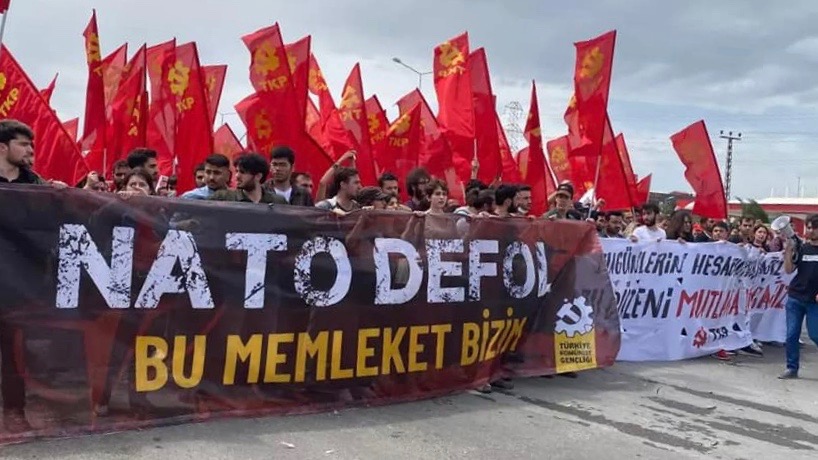
EDITOR’S NOTE: this is the second installment of excerpts from the TKP (Communist Party of Turkey) political report which we are publishing over several successive postings. For those who wish to read the whole report now, it can be found at https://www.tkp.org.tr/en/party/tkp-14th-congress-political-report/.
Communism and the International Arena
Current situation
- Today, we cannot speak of a world communist movement consisting of elements with a strategic partnership and moving in the same direction. This observation does not stem from an expectation of an international movement that eliminates differences and operates with homogeneous and advanced coordination. We know that communist parties can only have such a relationship and homogeneous positioning under very specific conditions. What we are referring to here is the absence of a common ground that communist parties interpret their existence upon. The emergence of certain groups of parties looking at different directions is not sufficient to define a world communist movement.
- Nevertheless, the existence of numerous parties coming together at the International Meetings of Communist and Workers’ Parties (IMCWP) today holds great value. Amid the dark reality that emerged after the dissolution of the Soviet Union, these meetings, largely due to the special efforts of some parties, notably the Communist Party of Greece, have become both a sign and a tool of the international presence of communist parties. However, as time progresses, the IMCWP faces not only deep ideological differences among its components but also the inability to renew the meeting format to make this platform more functional, resulting in issues of productivity and enthusiasm loss. While there is no sign in the near future that this issue will be resolved, the continuation of the IMCWP is in the interest of all member parties.
- It is evident that the parties participating in the International Meetings of Communist and Workers’ Parties describe each other with various adjectives. It is natural for TKP to have certain evaluations regarding member parties and to feel close to some and distant from others. However, the idea of opening the IMCWP to non-communist forces must be rejected. While there are many platforms operating internationally under labels such as “left,” “progressive,” and “anti-imperialist,” adding a new one to these is not beneficial. On the contrary, it would be seriously problematic for a platform consisting of parties that declare their “communist” character to open itself to non-communist forces.
- Communism has shown that it is not an actor that will disappear from the social and political plane, as some thought and hoped, following the difficult years after the dissolution of the Soviet Union. The diversity of subjects operating under the name of communism and the great differences between them do not change this reality. Moreover, despite everything, today in many countries of the world, communist parties with organizational roots or historical legitimacy dating back to 1917 and the revolutionary period that followed are continuing their struggles. However, on an international scale, after the collapse of the USSR, communism has not become a current option against capitalism, which is struggling to manage the deep and unsolvable problems it has created and is unable to develop a solution, even if false, for humanity, thus being in a state of perpetual crisis. The failure to fulfill this historical responsibility has paved the way for new social democratic or far-right racist movements to emerge and fade in many countries. The rise of these “false solution” parties, which drag the working masses along and then leave them in despair and helplessness, are proof of the existence of a wide space and a historical opportunity for communist parties.
- Bold answers must be given to the question of why communism has not yet managed to appeal to the yearning of the working masses. Starting from our common history of the 20th century, the problems arising from the strategic choices of communists collectively or in individual countries must undoubtedly be evaluated in detail, and lessons must be learned. The historical cost of the cooperation policies with bourgeois parties that came to the fore in Europe starting from 1935 and the sacrifice of revolutionary opportunities to this political choice is blatantly evident. To think that the working masses in search do not realize that the heavy and indecent intervention attempt by Eurocommunism on the foundations of Marxism means waving a white flag to bourgeois dictatorship would be foolish.
- However, today, partly due to these choices, the communist movement is facing a problem that is incompatible with its revolutionary character. In an era where the political sphere is constantly shaped by the “new fetishism” of capital, communist parties are portrayed as actors from the past who “never quite succeeded.” Undoubtedly, the massive campaigns conducted by imperialists using tremendous resources have had a significant impact on creating this perception. However, attributing today’s predicament solely to these campaigns would be to simplify and underestimate the problem. Communist parties, being among the oldest parties in many countries due to their founding dates, after long years of arduous struggles, great successes, and at times great defeats, have ultimately not yet provided a solution to humanity’s problems. This is the widespread perception. Some communist parties or “former” communists, thinking that this perception cannot be overcome, try to rise by becoming part of the “new fetishism” in bourgeois politics and competing in this field, and eventually became part of bourgeois politics. Making politics through individuals, adopting the language of popular culture, retreating from Marxism-Leninism conceptually, deforming the culture of action and organizational life to make it open to liberal forms are links in this transformation. However, the pollution created by these initiatives, which are useless except as accessories to bourgeois politics, does not eliminate the existence of the problem. Communist parties must prove that they are not outdated.
- When they were founded and for a long period thereafter, communist parties struggled in close interaction with the dynamism created by an organized workers’ movement that always made its weight felt. The existence of a section of the working class that knew the mechanisms of exploitation, was familiar with basic Marxist concepts, had matured class consciousness, and developed a culture of action was a significant opportunity, even if the widespread influence of social democracy could not be broken. In this respect, although it varies from country to country, it must be acknowledged that a significant change has occurred today. Communism has become an external subject to the working class in many countries. Considering that trade union structures have no special assistance in this regard and cannot have any, it cannot be expected that communist parties will strengthen their class character solely by relying on historical experience. In this sense, new tools, a new language, and a revolutionary strategy that connects all these are needed. Currently, the problem of access to the working masses, including young people who are largely part of the working class or will be, is a pressing, international issue for communist parties that cannot be brushed aside. This problem cannot be overcome with the existing set of tools largely shaped by the 20th century. Reducing the issue to digitalization, the transformations in the field of communication and media, and the increasing influence of social media should be avoided, as it would pave the way for easy solutions and deformations that lead to populism.
- In fact, what will pave the way to the solution is strategic clarity. Ultimately, the organization of the working class is not a static activity independent of time and space. Creating an attractive center that will respond to the search of the working people, bring them together towards a goal, and make them combative requires the presence of a revolutionary strategy. This strategy does not have to be carried into the social field with content embodied in party militants, but it must point in the same direction at every scale and level. Tools for organization, means of addressing, forms of struggle, etc., are shaped and detailed according to this strategy. Today, the most fundamental problem of communism internationally is the inability to form a strategy and the consequent loss of existential meaning and value. Political programs cannot replace strategic thinking. The program of a communist party is indispensable for a revolutionary strategy and thus is the exit point. A revolutionary strategy, on the other hand, is the entirety of the political, ideological, and organizational activities to be carried out to open the way to the socialist revolution. While it is expected that the programs of communist parties fighting in different countries will be similar, it is foreseeable that their strategies may differ.
- No matter how comprehensive or detailed the struggle that communist parties wage for “democracy,” “peace,” and “independence” may be, it cannot replace a revolutionary strategy. These types of struggle topics can be an element determined in a socialist revolution process, but they cannot be the main link. This does not mean to belittle phenomena such as “democracy,” “peace,” and “independence,” but rather to remind their unique reality, freeing them from the determination of bourgeois ideology.
- One of the issues that has most occupied communists internationally in recent times is the stance to be taken towards countries, especially the Russian Federation and the People’s Republic of China, that distance themselves from or position themselves against the alliance system of U.S. imperialism. Two methods can be followed in approaching this issue, both of which should mutually reinforce each other. One is to subject these countries to theoretical analysis using the unique tools provided by Marxism-Leninism. We have a strong theoretical framework for crucial topics such as examining the class character of the social systems and political powers in these countries, determining their place within the imperialist system, and depicting the forms that the labor-capital contradiction takes and may take in these countries. This framework cannot be trivialized. Of course, we encounter gray areas in theoretical analysis as well. However, the existence of gray areas does not mean that Marxism can be stretched in all directions. Nevertheless, theoretical analysis alone is not sufficient to determine our approach to the issue in question. When considering countries like the Russian Federation and the People’s Republic of China, we must complement our theoretical analysis with a current assessment related to the “interests of the world revolution.” Since Marx, class struggles have repeatedly confronted us with critical issues that challenge the limits of our theoretical framework. In moments when no template or memorized approach sufficed, communists prevented disintegration by holding tightly to Marxist-Leninist theory on one hand, and politically flexed on the other in certain topics that sometimes enriched that theory or turned into necessary exceptions. Some of these turned into open fiascos and contributed to our theoretical framework with negative examples. However, in no case could communists avoid the problems imposed by life that cannot be solved with a purely theoretical stance. For example, the rapprochement of Soviet Russia with the bourgeois power in Germany, the country closest to revolution in Europe after the October Revolution, cannot be explained solely by “theoretical” analysis. The temporary alliance of the Soviet Union with U.S. and British imperialism during the Second World War also contains similar uniqueness. In this sense, the unique possibilities that Marxism provides us for explanation and simplification do not absolve us from the responsibility of facing complex problems.
- Theoretical discussions on fundamental issues related to the social and political systems of countries like the Russian Federation, the People’s Republic of China, Iran, and Brazil are not impossible but very difficult. No matter how far you stray from Marxism, you cannot change the fact that capital dominance prevails in these countries. Declarations of intent, political structures, the official ideology of the state, and historical backgrounds are important, but they cannot obscure the realities of the ownership of the means of production and the commodity economy. The arguments that these and similar examples have become hybrid socio-economic formations suitable for the balance of the age or that they represent a prolonged transition period to socialism or that the capitalists in these countries will be quickly eliminated from above when the time comes cannot be accepted as data from our perspective. These types of evaluations have a metaphysical content that deviates from the reach of the Marxist-Leninist tradition and also render communism, as a political movement, ineffective. In this sense, communist parties, particularly with regards to the People’s Republic of China, have no choice but to look primarily at the property relations, surplus value production, and capital accumulation processes in this country.
- At this point, in addition to theoretical considerations, it is necessary to approach the issue from the perspective of the interests of the world revolutionary process and the strategy of communist parties fighting in capitalist countries. As we have already seen examples in Turkey, a significant number of those who argue that the future of humanity or socialism depends on the defeat of U.S. imperialism by the People’s Republic of China and even the Russian Federation are aware of the fact that they are greatly distorting Marxist theory. The desire to balance the pessimism brought about by the dissolution of the Soviet Union and the inability of the labor movement to take the initiative with large actors that have real counterparts can be understood to a point. However, what needs to be questioned here is the lack of revolutionary entities and revolutionary strategy and action in such a geostrategic alignment. In a world where large capitalist companies, multinational consortia, massive trade agreements, regular and paid armies, intelligence organizations, weapons of mass destruction, and monopolistic media exist, nothing could be more absurd than expecting communists to take pride in the market share of a Chinese company or the ballistic missiles that Russia boasts as “state of the art.” The responsibility of communist parties worldwide is to actively and organizationally involve the working masses in the struggle against exploitation, which is the source of inequalities. In this sense, it is impossible to turn the model referred to as “Chinese Socialism” into a reference and source of inspiration. TKP’s stance does not mean disinterest in the internal discussions and dynamics of the Communist Party of China, which has a tremendous accumulation of struggle, and political and ideological changes that may take place in this country.
- This analysis does not mean that TKP approaches the international arena with certain clichés and templates. The crisis of imperialist hegemony continues, and capitalism cannot develop a model that can offer humanity hope, not even a false one. The dominance of capital in all countries is faced with deep political and ideological disarray. Under these historical conditions, which invite the revolutionary intervention of the working class, the void left by socialism, the only alternative to capitalism, has led to an increase in gray areas worldwide. The endless variations produced by competition within imperialism, the shortening lifespan of alliance systems, the expansion of the maneuvering space of actors lower in the imperialist hierarchy, and the less visible class contradictions necessitate much more meticulousness from communist parties when determining priorities and critical links in the revolutionary struggle. In this sense, the TKP will continue its approach outlined in the “Theses on Imperialism,” which became one of the party’s fundamental documents with the 2017 Conference and will be updated with a conference to be organised exclusively to address this issue in 2025. TKP will shape its political initiatives and language in accordance with its political priorities, while absolutely rejecting collaboration with the capitalist class and not compromising on the fact that the relevance of socialist revolution is a universal strategic element. On the international stage, TKP will not follow a line that equates and balances the struggle against U.S. imperialism, the European Union, and NATO with the struggle against other actors.
- The contradictions, rivalries and conflicts within the imperialist system have different effects on the ongoing class struggles in individual countries, and communist parties may face different responsibilities and opportunities as a result of these effects. In each case, the relations between the principles of Marxism-Leninism and a socialist revolutionary perspective and the specific tasks that the contradictions within the imperialist system impose on the revolutionaries of a given country must be dealt with in a creative and revolutionary manner. Every communist party must look at the totality formed by international dynamics and the internal dynamics of individual countries from the point of view of the interests of the world revolutionary process. However, since the primary task of the communist parties is to overthrow the rule of capital in their own countries, they must approach the interests of the world revolutionary process from the perspective of their struggle for socialist power. Throughout history and today it is clear that a tension arises between the dominant needs of the world revolutionary process at the moment and the tasks posed by the revolutionary struggle in individual countries, which at times becomes difficult to resolve. There is no formula that can be applied to each of these tensions, nor is it possible to formulate a strategy by ignoring these tensions. Today, all of the hot agendas such as Iraq, Syria, Ukraine, Palestine, Sudan, Venezuela have to be addressed in line with the interests of the world revolutionary process, taking into account their specificities and undoubtedly from the perspective of the socialist revolutionary struggle in Turkey. Under conditions where the working class remains ineffective on the international scale and the world revolution does not make its own prominence felt conjuncturally, it is one of the most challenging tasks of this period for the communists to analyse all these topics without giving a chance to dogmatic and opportunist tendencies and to display a revolutionary positioning.
- On the international stage, socialist Cuba deserves to be evaluated in a separate category. The resistance shown by Cuba to date, and its determination to defend the achievements of the revolution, despite the severe imperialist aggression led by the United States after the dissolution of the Soviet Union, deserve every kind of praise. Although the economic practices conflicting with the process of socialist construction accompany this resistance and determination, which is understandable given the specific conditions of Cuba, it is a cause for concern for all communists. If the expanding private sector is not seen as a temporary retreat and is not kept under control through continuous interventions that ensure ideological vigilance, political oversight, and the determinative role of state ownership in the economy, a rupture that will eliminate the socialist character of the country will become inevitable. It appears that the leadership of the Communist Party of Cuba is aware of this danger. Nevertheless, the increasing inequalities in the country invite social decay and bring with them ideological-political problems that are difficult to overcome given today’s world balance. While the TKP evaluates the NEP period in Russia with a historical point of view and with understanding, which included some elements almost impossible for a communist to stomach, even in a country with vast resources, it certainly finds the compulsory retreats of Cuba, which is besieged and isolated in many respects, legitimate and justified. Asking Cubans to be driven into hunger and deprivation with unrealistic, abstract and romantic revolutionary actions cannot only be seen as foolishness; there is also a moral issue here. On the other hand, considering the possibility that Cuba might be dragged into a capitalist restoration if adequate vigilance is not shown and striving to prevent this is the duty of every communist.
- Communist parties in many countries are being oppressed by governments, subjected to physical attacks and bans. Often, such attacks are accompanied by accusations of serving external forces, even imperialist countries. It is not new that the regimes of capital attribute every justified reaction and struggle to “external forces’ incitement” to conceal their anti-people policies. On the other hand, it is a fact that the opposition in many countries, primarily the USA, Germany, and France, is supported, protected, and funded by other countries. It is observed that some “revolutionary,” “progressive,” or “leftist” parties or movements do not hesitate to enter into such relationships. No pressure or attack justifies receiving support from imperialist countries or entering into alliances with them. Communists must take an uncompromising stance on this issue, constantly share their red lines with the public, and not allow the slightest contamination within their ranks. Such determination is also the best response to the accusation of “serving imperialism.” Because under no pretext can communists suspend the struggle for socialism against exploitation.
Tasks of the party
- The Communist Party of Turkey strives to strengthen Marxist-Leninist parties with a revolutionary perspective on a global scale, contributing to platforms such as the European Communist Movement (ECA) and the International Communist Review (ICR), among others, where it plays a role. It deepens relationships with friendly and fraternal parties participating in these platforms. In the same vein, it pursues regional collaborations and enhances bilateral relationships.
- TKP continues to contribute to efforts aimed at making the International Meetings of Communist and Workers’ Parties more productive, maintaining relationships based on mutual respect and understanding with all parties participating in these meetings.
- Setting aside the political movements that have become a permanent and inseparable part of mainstream politics, detached from Marxism, become instruments of any imperialist bloc or those do not harbor a revolutionary dynamism within themselves, TKP establishes relationships at different levels and contents with all parties. Taking into account that many parties are undergoing changes in one direction or another under current conditions, TKP adopts a constructive approach to understand and engage with these parties without interfering in their internal affairs, aiming for this transformation to acquire a revolutionary character. It takes steps towards the formation of healthy channels for discussion and interaction on the international stage.
- TKP pays attention to further deepening the longstanding and evolving cooperation with the Communist Party of Greece (KKE). The positions gained by KKE within the working class and youth, its steadfast defense of socialism and a revolutionary perspective, its uncompromising stance on many critical issues, and its international work deserve great interest and respect. TKP is aware of some nuances between the two parties arising from the historical and social specificities of the two countries. These enrich the relationship with the KKE and make it more valuable.
- TKP attaches great importance to the organizational and political independence of communist parties, opposes interventions by other forces against the right of communist parties to exist, and stands in solidarity with communist parties facing such interventions.
- TKP strengthens solidarity with socialist Cuba and does its part to deepen fraternal relations with the Communist Party of Cuba. It fulfills the requirements of the cooperation protocol signed with the Communist Party of Cuba this year.
- TKP acts with the understanding that the organizational independence of communist parties is the sole guarantee against interventions aimed at their right to exist by other powers. It is expected that communist parties will demonstrate a political and moral stance against “bribes” such as creating space in mainstream politics, obtaining seats on one level or another, or providing material resources. In this regard, TKP relies only on itself and the organized power of the working class, creates its own resources, and does not consider any position or gain that is not a product of its own struggle as a success.
- The Congress emphasizes the need to accelerate the efforts to restructure the field of international relations as a critical element of the party’s revolutionary strategy. Given the fact that all aspects of the Political Report have an international dimension, the party maintains its external relations with a dynamic approach that aligns with the established political goals. It avoids relationship forms that are often energy-draining, formal, cumbersome, and at times turn into political tourism.
- Within the framework of all these principles and approaches, the party intensifies its activities for communism to become a more effective movement worldwide. The 14th Congress sets the goal of developing publishing activities in this regard, emphasizing bilateral discussions, and organizing regional meetings and conferences.


This a document that should be studied by communists around the world. It has much to offer to all those who truly a socialist revolution that abolishes the exploitative capitalist system. It accurately assesses the current state of communist parties and the at times overwhelming challenges facing them.